Best AM4 CPUs for Gaming in 2026: Ranked by Budget and Use Case
Verified specs, real pricing, and cited benchmarks for every AM4 CPU worth buying this year.
AM4 just turned ten. That’s a long run for a CPU socket, and it’s still one of the busiest ones on the market. This guide covers the best AM4 processor options actually worth considering in 2026, starting with the budget-friendly Ryzen 5 3600 and going all the way up to the 16-core Ryzen 9 5950X. Each one suits a different kind of build, so whether you’re starting from scratch or squeezing more life out of an old AM4 rig, there’s a pick here for you.
Every spec here comes straight from official manufacturer documentation, and we checked current pricing across major retailers before writing a single number down. Performance figures come from dated, named benchmark sources cited in the tables below, not estimated. If you’ve already got an AM4 board sitting in your case, the picks below should tell you exactly how far one CPU swap can take it.

Quick Picks
The full AM4 CPU list below covers everything from six-core budget chips to the 16-core flagship, with these AM4 CPUs ranked by where they actually fit in a build rather than by raw specs alone.
Quick Comparison Table
| CPU | Cores/Threads | Boost Clock | L3 Cache | TDP | Price (Aug 2026) | Best For |
| Ryzen 5 3600 | 6/12 | 4.2 GHz | 32 MB | 65W | $60–100 (used) | Tightest budget builds |
| Ryzen 5 5500 | 6/12 | 4.2 GHz | 16 MB | 65W | $100–120 | Entry-level 1080p |
| Ryzen 5 5600 | 6/12 | 4.4 GHz | 32 MB | 65W | $130–150 | Best value pick |
| Ryzen 5 5600X3D | 6/12 | 4.4 GHz | 96 MB | 105W | $150–180 | High cache on a budget |
| Ryzen 7 5700X | 8/16 | 4.6 GHz | 32 MB | 65W | $175–230 | Gaming plus multitasking |
| Ryzen 7 5700X3D | 8/16 | 4.1 GHz | 96 MB | 105W | $190–250 | Near-5800X3D gaming for less |
| Ryzen 7 5800X | 8/16 | 4.7 GHz | 32 MB | 105W | $215–230 | Rarely a better buy than the 5700X |
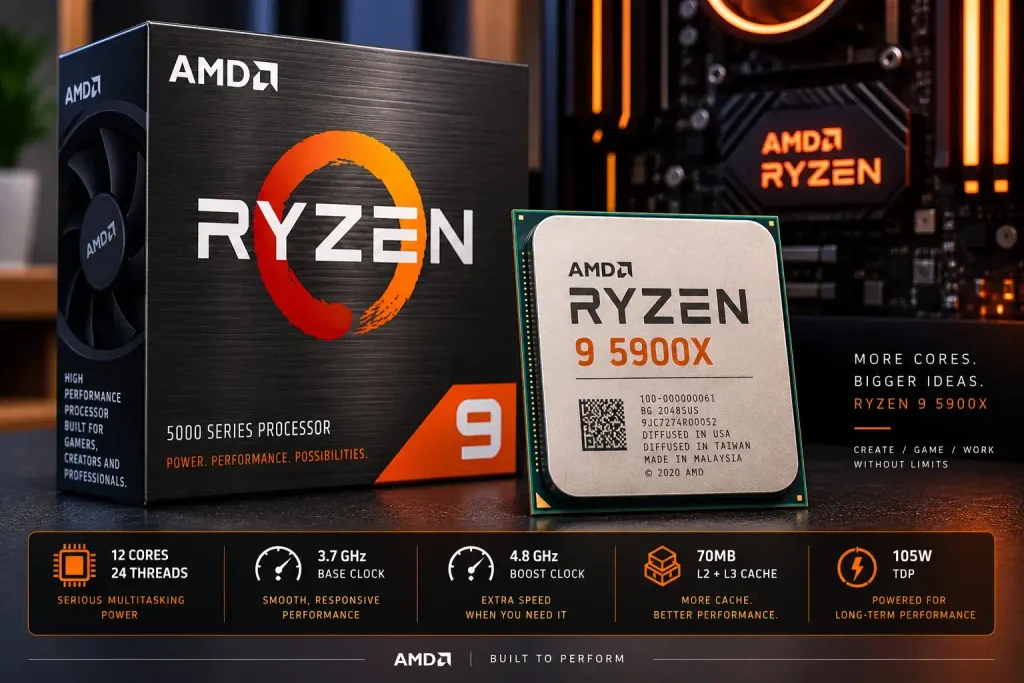
| Ryzen 9 5900X | 12/24 | 4.8 GHz | 64 MB | 105W | $300–330 | Heavy multitasking and content creation |
| Ryzen 9 5950X | 16/32 | 4.9 GHz | 64 MB | 105W | $280–450 | Most cores available on AM4 |
| Ryzen 7 5800X3D | 8/16 | 4.5 GHz | 96 MB | 105W | $349 (new, 10th Anniversary Edition) | Best gaming performance on AM4 |
Specs verified against AMD’s official documentation. Pricing reflects Newegg, Amazon, and eBay listings checked in August 2026.
Cache and Clock Speed Comparison
Cache size and clock speed are the two specs that matter most for gaming on AM4. The table above shows how much they vary across the lineup, from 16 MB on the Ryzen 5 5500 up to 96 MB on the X3D chips. In practice, the X3D models consistently outperform non-X3D chips with similar or even higher clock speeds, since AM4 games benefit more from extra cache than from raw GHz.
S-Tier: Ryzen 7 5800X3D
The Ryzen 7 5800X3D is still the strongest gaming chip AM4 ever got, and it holds that title as the best AM4 gaming CPU even four years after launch. AMD’s decision to bring it back this year confirms it. Its 96 MB of L3 cache, most of it stacked 3D V-Cache, keeps game data close to the cores instead of making repeated trips to system RAM. That is the main reason it still beats CPUs with higher clock speeds in games.
Tom’s Hardware tested the re-released chip against Intel’s Core i7-14700K in June 2026. Intel came out ahead overall, but only when paired with newer DDR5 memory. For anyone still running a DDR4 AM4 system, the 5800X3D remained the stronger drop-in upgrade, since it delivers a real performance gain without the added cost of a new motherboard and memory. The trade-off is price. At $349 for the new 10th Anniversary Edition, it costs more than a used Ryzen 5 3600 and a Ryzen 5 5600 combined.
Pair this chip with a mid-range or high-end GPU, such as an RTX 4070 Ti SUPER or stronger. Putting it behind a budget card wastes its cache advantage, since the GPU becomes the limiting factor long before the CPU does.

Ryzen 7 5800X3D : Gaming Performance
| Game | Settings | Avg FPS | Min FPS |
| Bodycam | 1080p, Ultra | 124 FPS | 117 FPS |
| Homeworld 3 | 1080p, Ultra | 161 FPS | 114 FPS |
| HELLDIVERS 2 | 1080p, Ultra | 180 FPS | 157 FPS |
| Atomic Heart | 1080p, Ultra, RTX | 65 FPS | 43 FPS |
Best for: Gamers who want the highest FPS AM4 can deliver and are not planning to move to AM5 soon.
If you already own a B550 or X570 board and a 65W-class cooler, budget for a cooler upgrade before buying this chip. Its 105W TDP rating means it is designed to run hotter than a six-core chip, and actual power draw under full load can run higher than the TDP figure suggests.
A-Tier: Ryzen 5 5600X3D
The Ryzen 5 5600X3D brings the same 96 MB of 3D V-Cache as the 5800X3D down to a six-core chip. It sits close behind the flagship in gaming despite costing roughly $170 less, since the shared cache size matters more for frame rates than the two extra cores on the 5800X3D.
It shares the same 105W TDP as the 5800X3D, since the stacked cache runs hot regardless of core count, so it needs the same tier of cooling as its eight-core sibling. The trade-off is fewer cores, which matters if you stream or run heavy background tasks while gaming.
Best for: Gamers who want near-flagship FPS without the flagship price or heat output.

A-Tier: Ryzen 7 5700X3D
AMD released the Ryzen 7 5700X3D in January 2024, almost two years after the original 5800X3D, as a lower-cost way to get most of the same gaming benefit. It carries the same 96 MB of 3D V-Cache and 8 cores, 16 threads, but runs at a lower 3.0 GHz base and 4.1 GHz boost clock and a 105W TDP.
Because AM4 gaming performance leans more on cache than clock speed, the gap between this chip and the full-price 5800X3D is smaller than the clock difference suggests. At $190 to $250, it usually costs $100 or more less than the 5800X3D while giving up only a modest amount of gaming performance, which makes it one of the best value picks on this list if you can find it in stock.
Best for: Gamers who want X3D-level cache without paying flagship pricing.

A-Tier: Ryzen 7 5700X
The Ryzen 7 5700X is the practical choice for anyone who wants eight cores without paying 5800X3D prices. It runs at a 65W TDP, the same as the six-core chips below it, which makes cooling simple even with a basic air cooler.
TechPowerUp’s review found it performs almost identically to the older Ryzen 7 5800X, just at a lower price point. That makes it a strong pick for gaming paired with background tasks like streaming or video encoding, where the extra two cores over the Ryzen 5 lineup actually get used.

Ryzen 7 5700X : Gaming Performance
| Game | Settings | Avg FPS | Min FPS |
| Gears of War: E-Day | 1080p, Ultra | 74 FPS | 63 FPS |
| Beast of Reincarnation | 1080p, Ultra | 107 FPS | 86 FPS |
| Halo: Campaign Evolved | 1080p, Ultra | 89 FPS | 77 FPS |
| 007 First Light | 1080p, Ultra | 96 FPS | 85 FPS |
Best for: Gaming plus streaming or content creation on a mid-range budget.
A note on the Ryzen 7 5800X: it shares the same cores, threads, and cache as the 5700X, but runs at higher clocks and a 105W TDP instead of 65W. Independent testing shows that clock advantage rarely shows up as a real gaming difference, so it only makes sense to buy if you find one meaningfully cheaper than a 5700X on the used market.
Most Cores: Ryzen 9 5950X
The Ryzen 9 5950X is the most powerful AM4 CPU by core count, with 16 cores and 32 threads, a 4.9 GHz boost clock, and 64 MB of L3 cache. It launched at $799 in 2020 and has since dropped to roughly $280 to $450 depending on retailer and condition, which makes its 16 cores far more accessible than at launch.
Despite AMD marketing the Ryzen 5000 series around gaming, the 5950X does not translate its extra cores into a gaming advantage over the 5900X or the X3D chips, since most games still lean on a handful of fast cores rather than sixteen. It makes the most sense for heavy production workloads like 3D rendering, video encoding, or compiling, where every additional core and thread gets used.
Best for: Content creators and professionals who need maximum multi-core throughput on AM4, not gamers.

Best for Multitasking: Ryzen 9 5900X
The Ryzen 9 5900X trades some gaming-focused cache for raw core count. With 12 cores and 24 threads, it handles video rendering, streaming, and heavy multitasking better than any other chip on this list, even though the X3D chips still lead it in pure gaming frame rates thanks to their larger cache.
PC Gamer’s original review called it a phenomenal processor that holds up in both serious workloads and games, and it still holds up for mixed use in 2026. Pricing has dropped sharply from its $549 launch price to around $300 to $330 today, which makes the core count much easier to justify.
Ryzen 9 5900X : Gaming Performance
| Game | Settings | Avg FPS | Min FPS |
| Gears of War: E-Day | 1080p, Ultra | 74 FPS | 64 FPS |
| Beast of Reincarnation | 1080p, Ultra | 109 FPS | 88 FPS |
| Halo: Campaign Evolved | 1080p, Ultra | 92 FPS | 81 FPS |
| LEGO Batman: Legacy of the Dark Knight | 1080p, Ultra | 140FPS | 108 FPS |
Best for: Streamers, editors, and anyone splitting time between gaming and productivity work
Best Value: Ryzen 5 5600
The Ryzen 5 5600 sits in the sweet spot of the AM4 lineup. It costs roughly $130 to $150, doubles the L3 cache of the Ryzen 5 5500, and its 4.4 GHz boost clock keeps single-core performance strong enough for most competitive games.
This is the chip most people should buy if they are building fresh on AM4 today rather than upgrading from an older Ryzen chip.
If your build is mostly for esports titles or 1080p gaming at high refresh rates, this is where your money goes furthest. Spending more only pays off once you move up to 1440p or start streaming alongside gaming
Best for: New AM4 builds on a mid-range budget.

Budget Pick: Ryzen 5 5500
The Ryzen 5 5500 is AMD’s cheapest current AM4 option, priced around $100 to $120 new. It shares the same core count and clock speeds as the Ryzen 5 3600, but with half the L3 cache, at 16 MB instead of 32 MB.
In practice, this makes it a close competitor to the used Ryzen 5 3600 rather than a clear upgrade over it. The main advantage is buying new, with a warranty, instead of gambling on a used chip’s condition.

Ryzen 5 5500: Gaming Performance
| Game | Settings | 1080p Avg FPS | 1% Low |
| Cyberpunk 2077 | 1080p | 68 FPS | 43 FPS |
| Battlefield 6 | 1080p, Ultra, TAA | 81 FPS | 58 FPS |
| GTA V Enhanced | Max Ray Tracing | 67 FPS | 52 FPS |
These numbers reflect a demanding mix of ray tracing and AI-heavy open-world titles. In lighter or competitive games, the Ryzen 5 5500 runs noticeably higher, often well past 100 FPS.
Best for: First-time builders who want a new CPU with a warranty on a tight budget
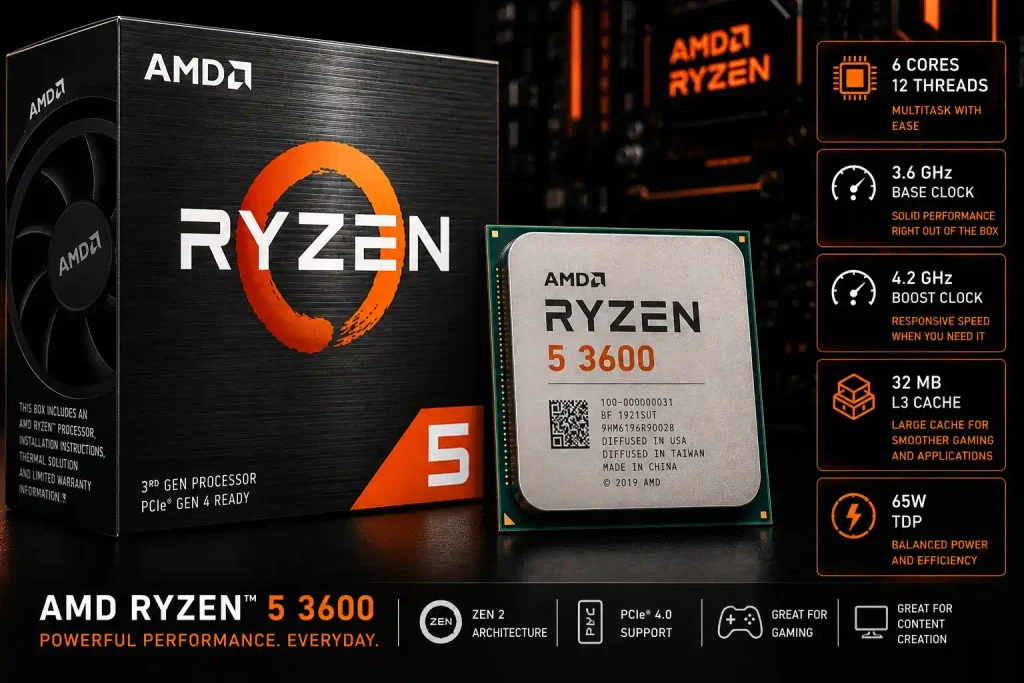
Best Used-Market Pick: Ryzen 5 3600
The Ryzen 5 3600 launched in 2019, and it is still one of the most searched CPUs on the platform. Used units now sell for $60 to $100 on eBay and PCPartPicker, often a third of the original $199 launch price.
It still handles 1080p and even 1440p gaming with a mid-range GPU. Where it struggles is competitive titles at high refresh rates, where its older Zen 2 architecture and smaller cache fall behind the newer Ryzen 5000 chips above it.
If you are buying this used, ask the seller for a screenshot from a stress test or CPU-Z validation before paying. It is a reliable chip, but seven years of previous use means condition varies more than with a new part.
Best for: Builders on a strict budget who already have an AM4 motherboard or are buying used parts.
AM4 CPU Buying Guide by Budget
| Your Budget | Recommended CPU | 1%Why Low |
| Under $100 | Ryzen 5 3600 (used) | Lowest cost per core on the platform |
| $100 to $150 | Ryzen 5 5600 | Best balance of price and cache |
| $150 to $230 | Ryzen 7 5700X | Eight cores for gaming and multitasking |
| $190 to $250 | Ryzen 7 5700X3D | Most gaming performance per dollar with 3D V-Cache |
| $280 to $330 | Ryzen 9 5900X or 5950X (used) | Best core count for streaming, editing, or rendering |
| $350 and up | Ryzen 7 5800X3D | Highest gaming performance AM4 offers |
If you find a used Ryzen 7 5800X priced well below a new Ryzen 7 5700X, it is a reasonable substitute in the $150 to $230 range, though the 5700X remains the better default pick at similar pricing.
Installation and Cooling Notes
AM4 chips use exposed pins on the underside of the CPU rather than on the motherboard. Align the small triangle marker on the CPU with the one on the socket, and lower it in gently. Bent pins are the most common installation mistake on this platform, and they are usually avoidable with careful handling.
TDP is AMD’s thermal design rating, not a precise measurement of real-world power draw. Actual consumption under full load, especially on the X3D and Ryzen 9 chips, can run above the rated TDP, so treat these numbers as a guide to cooling tier rather than an exact wattage.
Cooling needs vary by chip. The 65W-TDP processors, including the Ryzen 5 5600 and Ryzen 7 5700X, run cool enough for a mid-range air cooler like a Cooler Master Hyper 212 or similar. The 105W-TDP chips, the Ryzen 5 5600X3D, Ryzen 7 5700X3D, Ryzen 9 5900X, Ryzen 9 5950X, and Ryzen 7 5800X3D, benefit from a larger tower cooler or an all-in-one liquid cooler, especially under sustained multi-core loads.
Applying thermal paste correctly matters more on the X3D chips. Their stacked cache runs hotter in a smaller area, so even mounting pressure and a quality thermal compound help keep temperatures stable during long gaming sessions.
Motherboard Chipset Compatibility
Not every AM4 motherboard supports every CPU on this list without a BIOS update. A320 and B450 boards almost always need one, since AMD only began rolling out Ryzen 5000 support for the 400 series in early 2021. B550 and X570 boards were sold with Ryzen 5000 support from AMD’s side, but that only means the chipset supports it, not that every individual board’s BIOS ships pre-updated. Boards manufactured or sold in the last few years are very likely already updated, but older stock or a used board that has never had its firmware touched can still need a flash. Check the exact BIOS version against the motherboard maker’s CPU support list before assuming it will work.
If you are buying a used motherboard along with a used CPU, check the seller’s BIOS version or update it yourself with a compatible older CPU before installing a Ryzen 5000 chip. Once BIOS support is confirmed, finding the best CPU for AM4 socket boards comes down to the same budget and use-case questions covered throughout this guide, not the socket itself.
Should You Buy New or Used?
Buying used makes sense on AM4 because the platform stopped receiving new CPU generations after the Ryzen 5000 series. A used Ryzen 5 3600, Ryzen 5 5600, or Ryzen 9 5900X from a reputable seller on eBay or PCPartPicker usually still has years of life left, since these chips run cool and rarely fail from normal use.
The price gap between new and used varies a lot by chip. A used Ryzen 5 3600 saves you roughly $100 to $140 off a comparable new Ryzen 5 5500 or 5600, which is the single biggest budget lever on this list. A used Ryzen 9 5950X can run $280 to $300, well under half its $799 launch price, since demand for 16-core AM4 chips has dropped as buyers move to AM5. X3D chips hold their value better on the used market because demand for their gaming performance stays high, so the savings versus new are usually smaller, often only $30 to $60 off a used Ryzen 5 5600X3D or Ryzen 7 5700X3D.
Buying new makes more sense for the Ryzen 7 5800X3D, since AMD’s 10th Anniversary Edition comes with a fresh warranty and a bundled thermal pad. At $349, it is also priced closer to entry-level AM5 chips, so the decision comes down to whether you already own AM4 memory and a motherboard worth keeping
Is AM4 Still Worth It in 2026?
For most builders already on AM4, yes. A CPU upgrade costs far less than switching to AM5, since it skips a new motherboard and DDR5 memory entirely. The platform’s ceiling is the Ryzen 7 5800X3D, so if your goals go beyond that, AM5 becomes the better long-term choice. For a closer look at how AM4 compares to AM5 on socket design, RAM support, and upgrade paths, see our AM4 socket guide.
Frequently Asked Questions (FAQs)
Conclusion
Choosing the best AM4 CPU in 2026 comes down to budget and what you already own. Every chip on this list is a Ryzen, so picking the best AM4 Ryzen CPU really just means matching one of these to your use case: the Ryzen 7 5800X3D remains the fastest option for gaming, while the Ryzen 7 5700X3D gets close to that performance for noticeably less money. The Ryzen 5 5600 offers the best value for most builders building fresh. On a tight budget, the used Ryzen 5 3600 and the new Ryzen 5 5500 are the strongest picks, and both work well as a first upgrade. For the heaviest multi-core workloads, the Ryzen 9 5950X remains the most capable chip on this platform, even if the Ryzen 9 5900X is the more practical buy for most people.